

RAGAA at the heart of the global debate on feminist foreign policy in Madrid
Over three intense days, Madrid became the world capital of feminist foreign policy. The RAGAA (Raise Against Gender Apartheid in Afghanistan) initiative, represented by its partners FIBGAR and PeopleHelp, had the privilege of being present at three key spaces that brought together civil society, parliamentarians, governments and international organisations around a common agenda: advancing equality, human rights and justice as fundamental pillars of peace and democracy.
The week began at the headquarters of the Spanish Agency for International Development Cooperation (AECID), where the Civil Society Forum for Feminist Foreign Policy brought together approximately 300 representatives of civil society organisations, think tanks, activists and feminist movements from around the world. The Forum reflected one of the central commitments of Feminist Foreign Policy: that civil society and women's organisations are not mere observers of diplomacy, but essential actors in the design and implementation of more inclusive and transformative policies.
RAGAA's presence at this Forum was an opportunity to bring forward a perspective the initiative holds firmly: feminist foreign policy must urgently address accountability for serious violations and gender-based crimes — and the case of Afghanistan is today one of the most urgent and undeniable.
The following morning, the Parliamentary Dialogue "Feminist foreign policy from parliaments: rights, equality and global justice", held at the Congress of Deputies, offered another relevant space. The parliamentary conversation reinforced a central conviction of RAGAA: feminist foreign policy and the strengthening of democracy are inseparable, and parliaments have a key role in translating international commitments into concrete legislative action.
The centrepiece of the week was the V Ministerial Conference on Feminist Foreign Policy, held at the Ministry of Foreign Affairs on 2 and 3 June 2026. Under the motto "Building peace and democracy", the Conference brought together more than 700 participants: representatives from around 60 Foreign Affairs ministries, senior United Nations officials, and more than 140 civil society organisations from around the world.
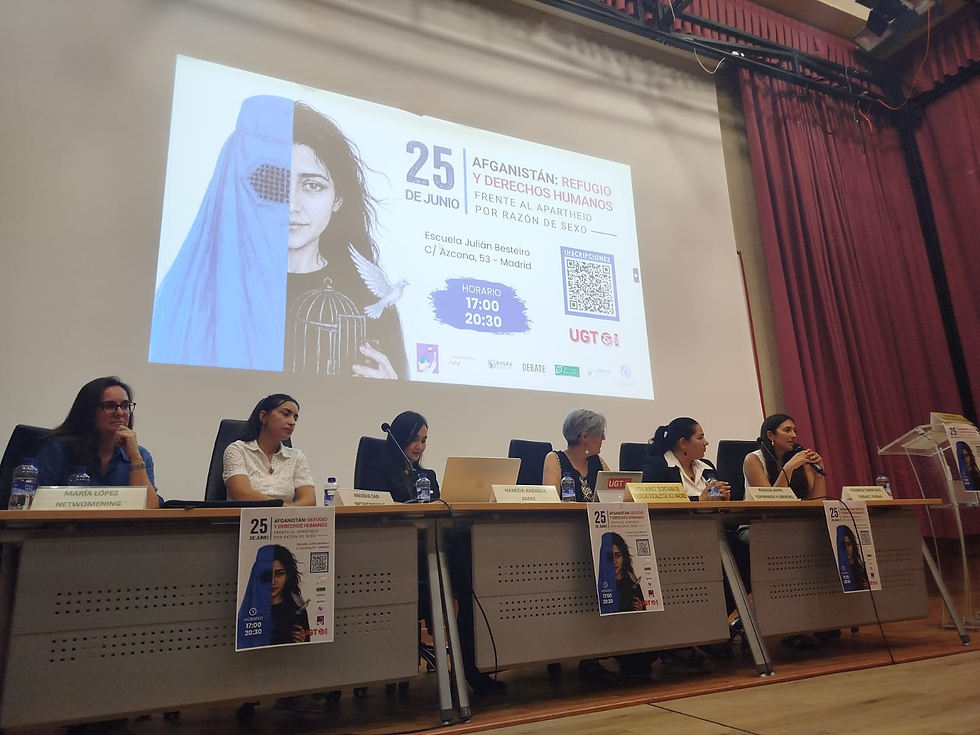
In this context, RAGAA supported the panel "Dismantling Gender Apartheid: Women's Leadership, Accountability and State Responsibility". The panel addressed the situation of women in Afghanistan under the Taliban regime, internationally recognised as a case of gender apartheid, and debated the need for states to act with concrete accountability mechanisms, as well as the indispensable role of Afghan women's leadership, inside and outside the country, in any process of change towards democracy.

Comments