

Gender Apartheid under International Criminal Law: A Decisive Opportunity at the UN Preparatory Committee
- Feb 9
- 5 min read
Following the Second World War, crimes against humanity were conceived as a revolutionary category capable of sanctioning atrocities committed against civilian populations. However, unlike war crimes—codified through the Four Geneva Conventions of 1949 and their Additional Protocols—and genocide—addressed in the 1948 Convention—crimes against humanity were never regulated through a standalone treaty.
For decades, their development remained confined to fragmented instruments, including the Rome Statute of the International Criminal Court (ICC). While this represented a significant step forward, structural limitations persist: it does not establish an enforceable duty of prevention, does not provide for State responsibility—focusing solely on individual criminal liability—and its obligations are not binding for non-States Parties.
To address these gaps, the United Nations International Law Commission (ILC) initiated a dedicated study on crimes against humanity in 2013 and incorporated the topic into its active agenda in 2014. In 2017, it published a first set of draft articles, which received comments from States, civil society, and UN bodies. In 2019, the Commission adopted a second and final set of draft articles with accompanying commentary, which was submitted to the General Assembly with a recommendation to commence treaty negotiations.
Ending years of institutional stalemate, the General Assembly adopted Resolution 79/122, establishing a roadmap for the drafting of a Convention. Over the next four years, the treaty text will take its definitive form. States have until the end of April 2026 to submit amendments to the draft articles, which will be consolidated into a single “compiled text” for negotiation. Subsequently, a Diplomatic Conference will be held in two sessions of three weeks each, scheduled for early 2028 and 2029, with the possibility of an additional session if necessary. The current session of the Preparatory Committee formally inaugurates this process.
A central focus of the debate is the incorporation of a gender justice perspective in the future Convention, both through the inclusion of specific crimes and the transversal application of a gender approach.
In this context, the proposal to recognise gender apartheid as an autonomous crime against humanity has gained particular relevance.
This proposal is grounded in the lived experiences of women, girls, and LGBTIQ+ persons in Afghanistan, which since the Taliban’s return to power in August 2021 has become the most extreme example of institutionalised discrimination against women and girls in the contemporary world. Decrees issued by the regime have prohibited access to education, employment, public life, and freedom of movement, establishing a system of governance based on an explicit gender hierarchy. This situation has been widely documented by the UN Special Rapporteur on the situation of human rights in Afghanistan and the Committee on the Elimination of Discrimination against Women (CEDAW).
On 8 July 2025, the ICC Pre-Trial Chamber II issued arrest warrants against Haibatullah Akhundzada and Abdul Hakim Haqqani for their alleged responsibility for crimes against humanity consisting of persecution on gender grounds (Art. 7.1(h) of the Rome Statute). However, this offence addresses the effects of oppression and deprivation of rights, but not the institutional design that produces them, nor the intent to perpetuate a long-term regime of domination. In other words, it identifies the symptoms, but not the legal-political system that generates them.
Against this backdrop, a growing consensus has emerged that what is occurring in Afghanistan constitutes a system of domination comparable to apartheid, characterised by its institutionalised nature, systematic implementation, and political objective of total subordination of a group. Traditionally, however, apartheid has been associated with racial or ethnic criteria.
Consequently, the recognition of gender apartheid as an autonomous crime has gained momentum, representing a coherent and necessary evolution of the existing legal framework.
In 2023, the Working Group on Discrimination against Women and Girls and the Special Rapporteur on Afghanistan formally proposed a legal definition of gender apartheid in a joint report to the Human Rights Council (A/HRC/53/21).
From a legal perspective, gender apartheid can be defined as a set of inhumane acts committed within the context of an institutionalised regime of systematic oppression and domination of one gender group over another, with the intent to maintain such a regime over time. It does not concern isolated acts of discrimination or individual rights violations, but rather a deliberately designed normative, political, and social system intended to ensure the structural subordination of a gender-defined group.
This definition draws directly from the crime of apartheid, as reflected in Article 7.2(h) of the Rome Statute and the 1973 Apartheid Convention, adapting its essential logic—domination, hierarchy, and systematic exclusion—to the axis of gender.
Since then, a growing coalition of States, civil society organisations, and international mechanisms has expressed support for its codification. By May 2024, at least ten States had signalled their openness to exploring this possibility, and in October 2025, the European Parliament declared that the European Union would support the recognition of gender apartheid as a crime against humanity. More recently, UN experts have urged States to include it in the draft Convention text, emphasising the need for meaningful participation of women in the drafting process.
The legal implications of advancing—or failing to advance—its recognition are profound. Codifying gender apartheid would legally highlight the scale of structural oppression faced by women, girls, and LGBTIQ+ persons under institutionalised regimes of domination. It would strengthen prevention obligations, close normative gaps in international criminal law, and reinforce accountability mechanisms at both national and international levels. Moreover, it would send a clear normative message: institutionalised supremacy of one gender over another constitutes one of the gravest forms of international criminality.
Conversely, failing to recognise it would perpetuate fragmented and insufficient protection, forcing complex realities of systemic oppression into criminal categories designed for other dynamics. This would undermine not only the effectiveness of the system but also its expressive function, essential to the legitimacy of international criminal law.
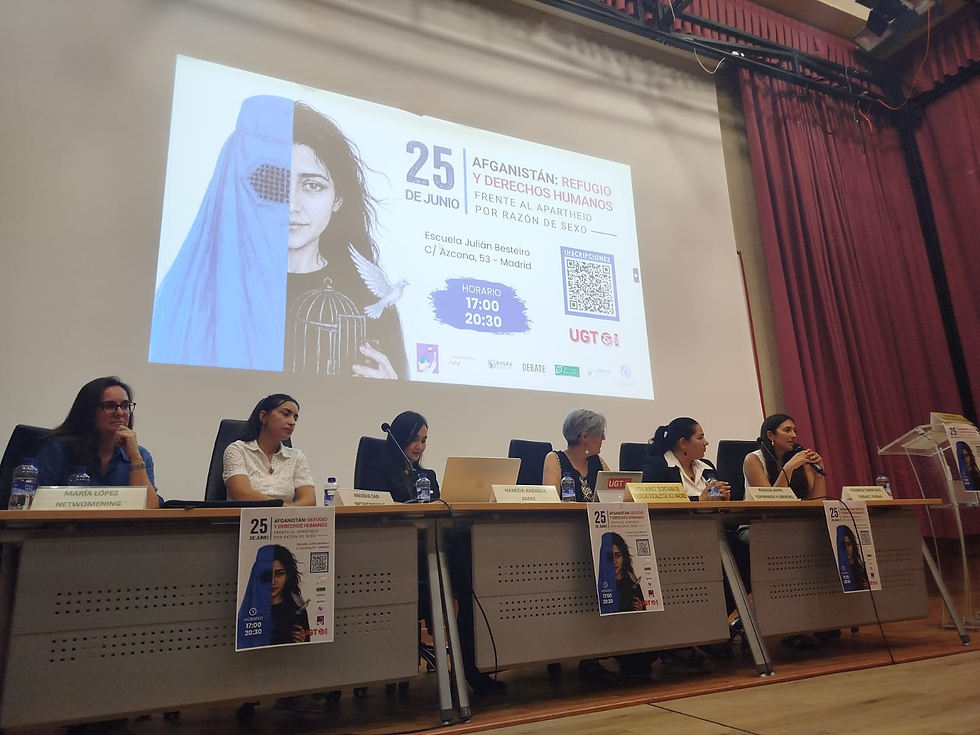
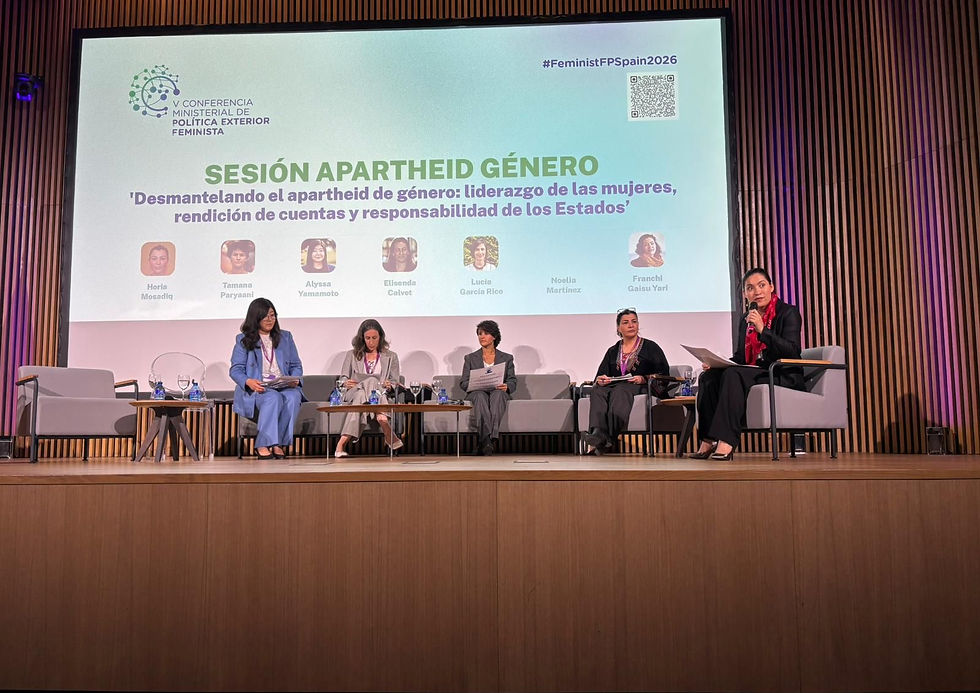
In this debate, the role of civil society has been and will continue to be decisive throughout the coming years of the negotiation process. In Spain, the initiative RAGAA—Raise Against Gender Apartheid in Afghanistan—led by FIBGAR and People Help (PH), stands out. Its objective is to denounce systematic violence against women and girls in Afghanistan, promote international legal recognition of gender apartheid, provide protection to victims, and facilitate their access to justice. The project is currently in an active phase of advocacy and international coordination, contributing to alliance-building and mobilisation of state support.
The fight for the recognition of gender apartheid is not a sectoral cause but a collective responsibility. Especially today, when international criminal law faces moments of fragility and questioning, the process opened at the Preparatory Committee offers a historic opportunity to reaffirm its foundational promise: that no form of systematic oppression remains beyond the reach of the law.
This article was published on 29 January 2026 in Diario Jurídico and provided by the author, our coordinator and Director of FIBGAR, Alessia Schiavon, for reproduction.

Comments